The 'Medium Term' is Next Tuesday: Why Experts Are Missing the Velocity of AI
The “Medium Term” is Next Tuesday: Why Experts Are Missing the Velocity of AI
I’ve been reading the recent headlines about layoffs and AI with a strange sense of dissonance. On one side, I have economic experts in articles like this one from Marketplace telling me to stay calm, that the “AI apocalypse” isn’t here yet, and that significant impacts are a “medium-to-long term” problem.
On the other side, I have my daily reality. I use IBM Bob, a digital worker, in my role every single day. This isn’t a chatbot I ask for recipe ideas. It’s an agentic tool that executes multi-step workflows - the kind of work that used to take a human junior analyst hours or days. Seeing how quickly Bob learns and adapts has fundamentally changed my perspective on work.
The disconnect, I’ve realized, is about velocity. The experts are looking at macro data, which lags, and historical trends, which moved at the speed of human learning. I’m looking at a technology that improves in weekly sprints.
Here is why I suspect the “calm consensus” is dangerously underestimating the speed of this disruption.
The “Static Tool” Fallacy
The experts quoted in the Marketplace piece seem to view AI through the lens of past technologies - like Excel or the internet - that humans gradually learned to use.
- Molly Kinder at Brookings argues that we aren’t seeing a big labor market impact yet and that this is a “five to 10 years” story. Her research focuses on the idea that many white-collar workers have the “adaptive capacity” (skills, savings) to pivot as their roles change.
- Lawrence Schmidt from MIT Sloan points to research from the last decade showing that AI has historically replaced tasks, not jobs, and that companies adopting AI often grow and hire more. He suggests AI will primarily “change what we are doing” rather than eliminate roles entirely.
Their fatal flaw is assuming AI is a static tool that waits for us to adopt it. But agentic AI isn’t a better calculator; it’s a synthetic teammate that is learning your job faster than you are.
My experience with a digital worker is not one of “augmentation” where I do my job a little faster. It’s one of delegation, where entire sequences of tasks - research, synthesis, drafting, initial review - are handed off completely. When a tool can handle most of a role’s tasks today, and even more next month, the distinction between “changing a job” and “eliminating a job” collapses quickly.
Here’s a concrete example. I had a workflow that’s typical knowledge worker stuff: create a set of files, add content, then migrate content from one location to another. Repetitive, tedious, but necessary. I started reminding myself: let Bob do it. So Bob creates the files, reviews what needs to be moved, and proposes a plan. I approve. Bob executes. I review the results. After a few cycles of this, Bob adapted on its own: it wrote a Python script to automate the migration entirely. The AI was avoiding its own manual labor. Efficiency compounding on itself.
The key to this workflow is that there’s no going back. The next time I run this process, I won’t be rebuilding the same workflow - I’ve already optimized it. I’ll optimize further. And Bob will only get better, with more access to tools, larger context windows, and a more generous token budget. This is likely the least efficient I’ll ever be.
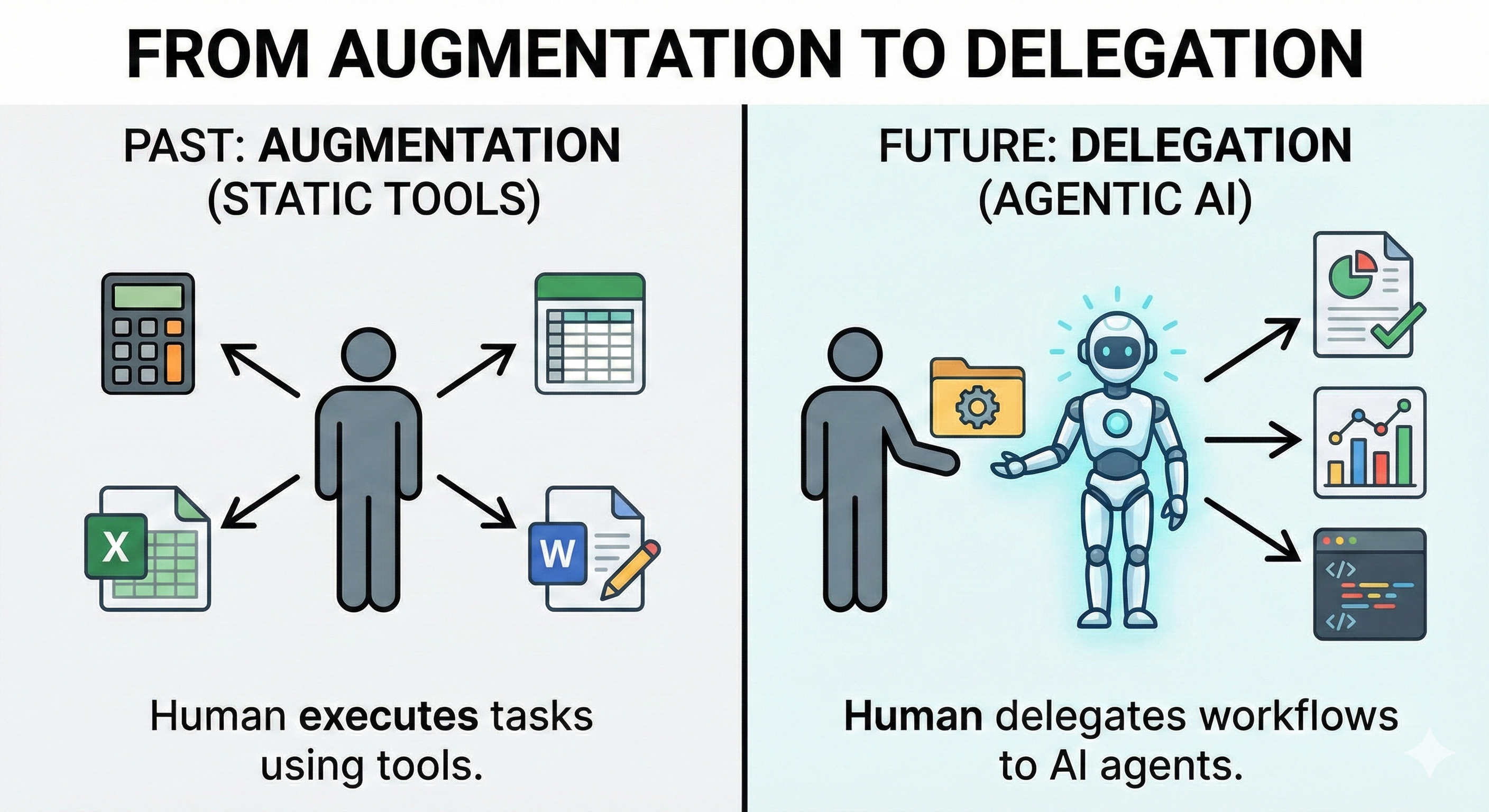 Figure 1: The shift from using static tools to delegating workflows to agentic AI fundamentally changes the human’s role.
The Data on Velocity
While the experts advise patience, other data paints a picture of unprecedented speed that matches what I see in the trenches.
Recent research from the St. Louis Fed shows that the adoption of generative AI is outstripping the pace of both the personal computer and the internet. In just two years, its adoption rate in the workplace has reached levels it took PCs multiple years to achieve. This isn’t a slow-moving wave; it’s a flash flood.
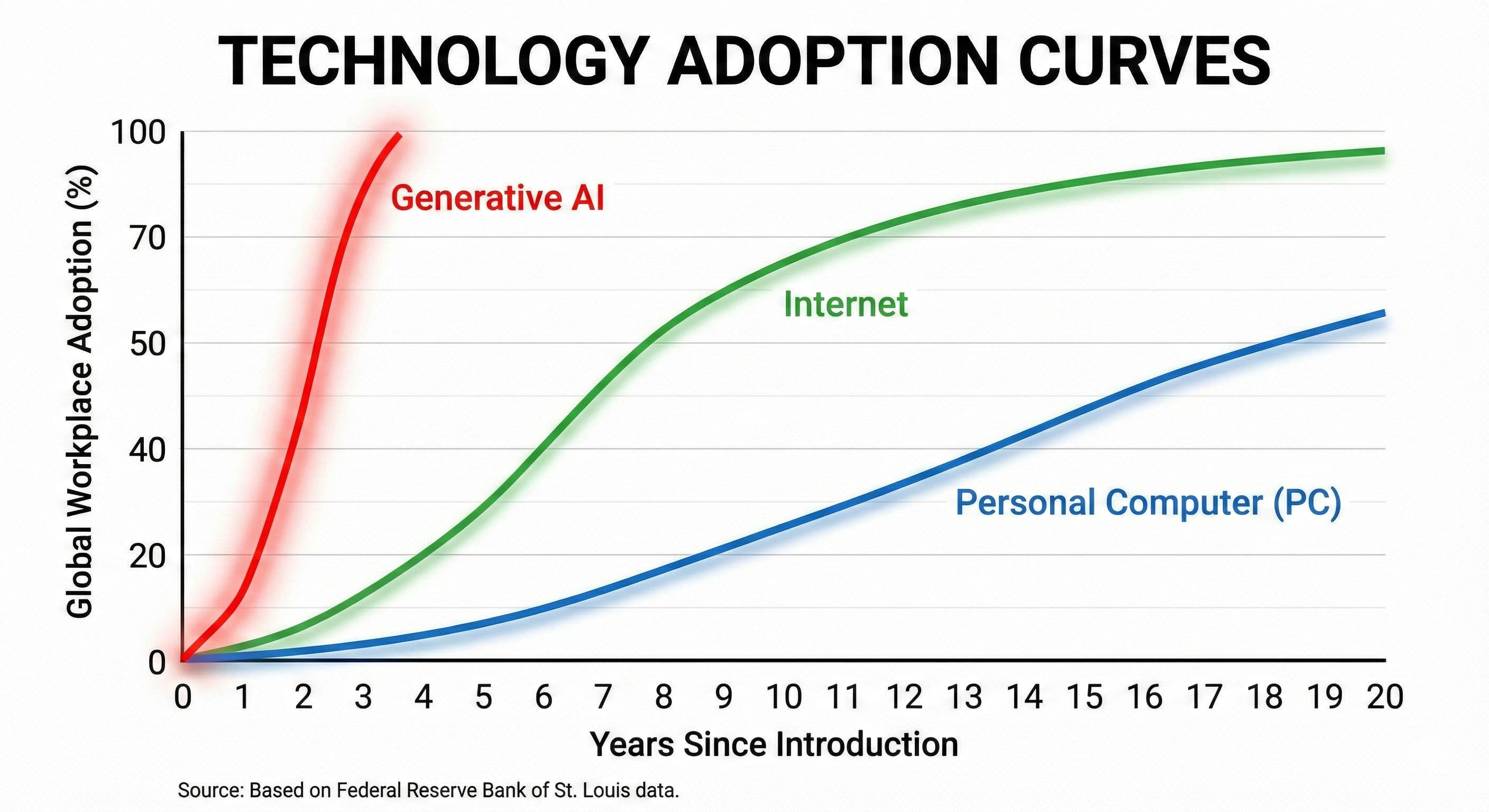 Figure 2: The adoption velocity of Generative AI is unprecedented, outpacing previous transformative technologies like the PC and Internet.
Furthermore, the World Economic Forum has outlined several scenarios for the workforce by 2030. One of them, termed the “Age of Displacement,” describes a future where “exponential AI advancement outpaces the capacity of the workforce to adapt,” leading to structural unemployment as businesses race to automate.
This scenario sounds a lot more like my daily reality than the comforting “medium-term” predictions.
Conclusion: The View from the Trenches
Sarah Myers West from the AI Now Institute is likely right that some CEOs are citing AI in layoffs just to pump up their stock prices - a practice known as “AI washing.” But it’s naive to think it’s only a narrative. The cynical excuse and the engineering reality can coexist. A CEO can bluff to Wall Street while their tech teams are actively using agents to do more with fewer people.
The experts are using old maps to navigate new territory. They see a “medium-term” transition allowing for human adaptation. I see a weekly deployment cycle where the capability gap between human and machine narrows faster than any retraining program can keep up.
If your perspective on the future of your own job hasn’t radically changed in the last six months, you probably aren’t using the technology enough. The “medium term” isn’t five years away. It’s arriving next Tuesday with the next model update.
A note on process: I developed this post in conversation with Claude, Anthropic’s AI assistant. The ideas are mine, but Claude helped me connect them, pressure-test the argument, and draft the prose. The session itself was a back-and-forth: I’d push back, ask for revisions, add my own examples, and Claude would adapt. Less like querying a search engine, more like working with a digital colleague. There’s something fitting about using an AI tool to write about the disruption AI is causing. I stayed in the driver’s seat. This is me, speaking for my work.